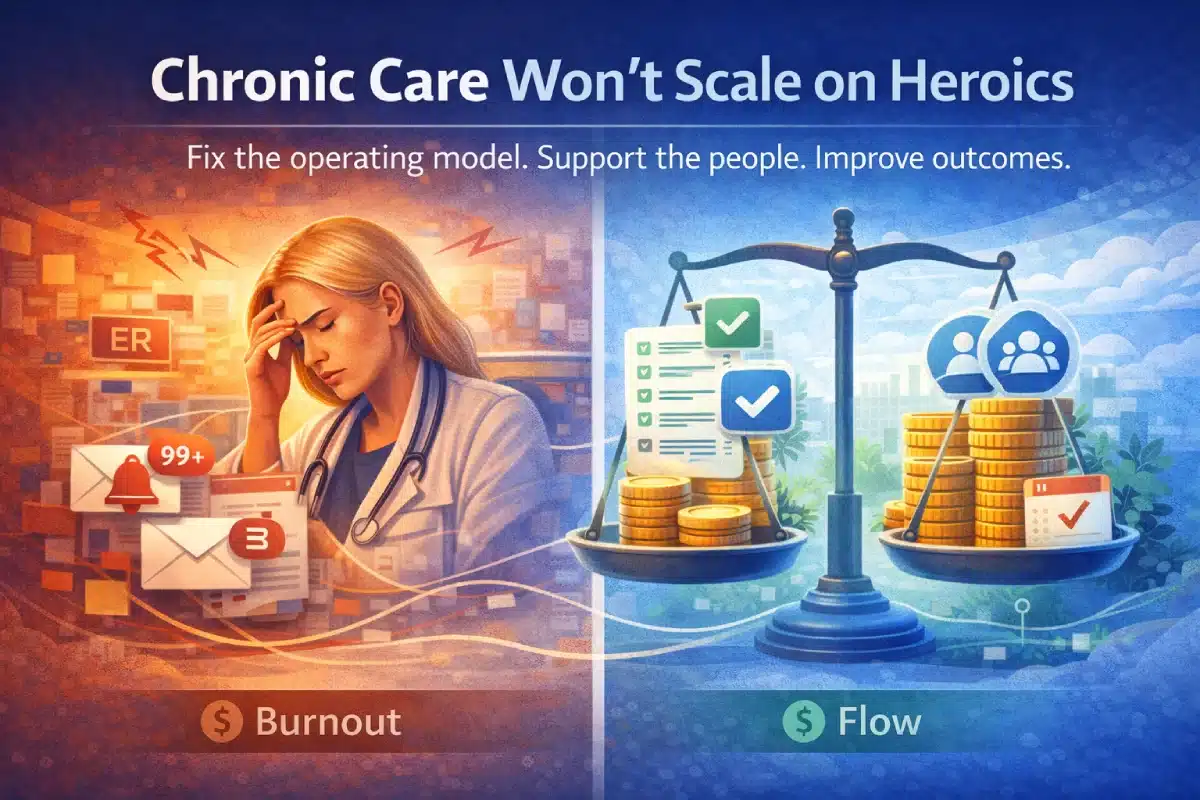

Medicare’s reimbursement landscape has evolved.
In 2026, the national average for CPT 99490 and the add-on code 99439 increased significantly, and a practice providing 40 minutes of monthly CCM services can now generate approximately $106 in additional revenue per serviced patient.
When a practice scales this to 750 enrolled patients, the annual CCM top line revenue is approximately $954,000. When that same practice implements Remote Patient Monitoring to track vitals like blood pressure or glucose levels, that figure can climb to $1.46 million per year.
Despite these promising figures, a gap remains. Many practices struggle with enrollment rates, often stalling below 10% of their eligible population. The difference between a struggling program and a $1 million revenue stream lies in a proven operating model to maximize opportunity.
Beyond Automation: The TimeDoc Health Difference
While some solutions rely on AI bots to handle patient check-ins, TimeDoc Health prioritizes a tech-enabled clinical service model. This approach balances high-tech efficiency with the human touch required to manage complex chronic conditions.
1. Seamless EHR Integration
One of the primary barriers to CCM success is administrative toggling. If care data lives in a separate silo from the patient’s primary chart, clinicians lose visibility.
TimeDoc Health provides bidirectional integration with over 50 EHR systems, including AthenaHealth, Epic, NextGen, and Allscripts. Vitals from RPM devices and notes from CCM check-ins flow directly into the patient’s existing chart. This ensures that when a provider sees a patient in the office, they have a complete, real-time picture of their health since the last visit.
2. Clinical Staff Augmentation
Staffing shortages continue to be the biggest hurdle for primary care. TimeDoc Health addresses this with our hybrid deployment model, time-tested over the past decade.
Practices can choose to use TimeDoc’s software with their own internal staff, or they can leverage TimeDoc’s in-house clinical care managers. These are medically trained professionals who act as a literal extension of the practice, calling patients, updating care plans, and identifying social determinants of health (SDOH) barriers that often go unnoticed.
3. Comprehensive Program Stacking
The path to $1+ million in revenue is paved by “stacking” complementary Medicare programs. TimeDoc Health enables practices to manage:
Chronic Care Management (CCM): Monthly coordination for patients with two or more chronic conditions.
Remote Patient Monitoring (RPM): Real-time tracking of physiological data via cellular-enabled scales, BP cuffs, and glucometers.
Behavioral Health Integration (BHI): Proactive mental health support, which studies show can reduce total healthcare expenditures by up to 17%.
Advanced Primary Care Management (APCM): New in 2025 and enhanced in 2026, APCM offers a broader, value-based approach to patient management.
The ROI of Retention and Outcomes
Revenue is the immediate benefit, but long-term success is built on patient retention and outcomes. Automated voice agents often suffer from high churn rates as patients disengage from repetitive, non-human interactions.
By contrast, the TimeDoc Health model focuses on building a care community around the patient. When a patient knows a real person is monitoring their blood pressure every morning, compliance increases. This leads to fewer emergency room visits, fewer hospitalizations, and a stronger performance in value-based care contracts.
For practices looking to capture the $1 million opportunity in 2026, the choice isn’t just between manual or automated. It’s about choosing a partner that can scale with clinical integrity.